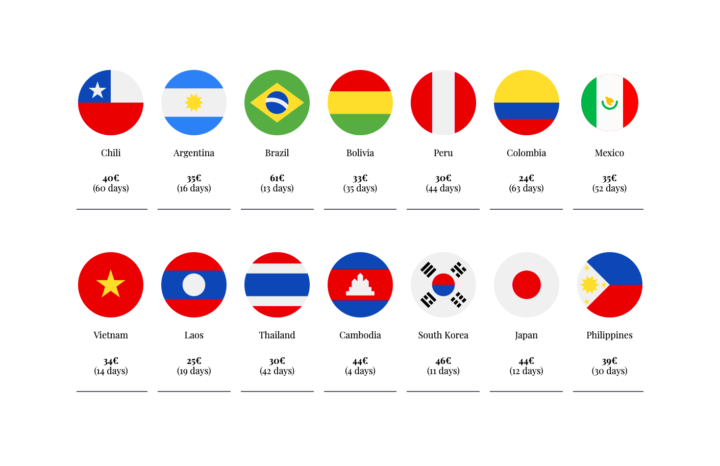
4 months after coming back, here is the full tale of our World Trip! We used Polarsteps as our journal, writing down all our adventures for our friends and family. We now have printed a book (332 pages) with some photos and graphics. Just a small teaser:
(more…)Category: Colombia
-

Budget for a World Trip
We travelled for 14 months and gathered all the prices thanks to TravelSpend application: Here is the detail of how much did we pay the planes, accommodations, activities, transportations, food… You will know all about what you should expect to spend on a World Trip!
(more…) -

Budget to travel to Colombia
We passed 2 months in Colombia, travelling from the ecuadorian border to the caribeen coast, from April 17th to June 19th.
Note: We are a couple travelling for 1 year and we’ve already spent half of our time and budget and time (20000€ total). The prices mentioned in this post are PER PERSON, except for the taxis and accommodation (usually private double rooms).

Food
We’ve found meals for 15 soles (starter/main course/drink included).
- Pizza: between 20 and 35K
- Full breakfast: between 5K and 10K per person

Drinks
- Water: Around 3K
- Beer: Between 6 and 8K
- Juice: 8K
- Coffee: between 1000 and 3000

Transportation
Bus:
- Pastos – Popayan 50K, to San Augustin 30K, Bogota to Medellin 87K, Medellin – Guatape 17K… For the rest please read the dedicated post.
- City bus:
– In Bogota they have a special bus way through the city (2800 one way and you need to pass with somebody),
– In Cartagena called TransCaribe will transport you from the airport to the city center, and from the city center to the bus terminal only for 2700pesos (ask again to somebody to use their card).
Colectivo:
The best experience we had is to take the Escolera bus from Jerico to Andes (15K)
Taxi:
Do not hesitate to use Uber, or even better Cabify in the main cities as Bogota and Medellin. The drive is about 20K.
Tramway/Funicular: in Medellin you need to buy 6K a card and each way is 3K (one way works for the tram + the funicular).

Accommodation
Country Minimum Maximum Average Colombia 30K 95K 55K € 7€ 22€ 12€60

Activities
We paid the entrance of San Augustin archeological parc 25K, el Purital 7K, National museum of Bogota 4K, golden museum 2K, and the most expensive was Tayrona 67,5K. For the rest please read the dedicated post.

Extras
- Phone: With Claro there was an offer for 20 soles 4Gb with Facebook and WhatsApp unlimited for 30 days (we used a chip a traveler gave us in Bolivia)
- Laundry: around 5s per kg
- Cigarets: 5soles a pack, 27soles 10packs (they call it “brazo”)
- Guarda Maleta: 3800 for 24h
Click on the title of the post

To follow those spendings we used TravelSpend App. Looking back…
Colombian budget was the cheapest in South America, thanks to the 18 days we spent without paying the accomodation (in Rincón we stayed 15 days for free in an hostel in exchange of a website, and we’ve been invited in Villa de Leyva by a very nice couple – THANKS again Valerie and Romi) we spent a total of 25€ per person per day. -

How to visit Tayrona
We founded hard to find information about Tayrona and how to visit the parc, where to start, what to visit, where to stay… So here is what we did and tips for you traveller: How to go to Tayrona? What to bring and how much money do I need? Where to sleep? What itinerary to visit Tayrona main part? What we did.
Let me first tell you that this place is a real paradise and a must do if you go to Colombia! Blue transparent and warm water, huge jungle full of monkeys, white sand beaches and lot of postcard landscapes! I only share here our experience, we didn’t visit Palangana area (Cinto, Playa Cristal…).
How to go to Tayrona?
Option 1: By bus & minimum 2h walk
The cheapest way to go to Tayrona parc entrances is the bus: one of the various you have between Santa Marta and Buritaca, Palomino or Riohacha. You ask to the driver to leave you at Calabazo (30min from Santa Marta) or el Zaino, the easiest part for trekking (it’s the main one: 45min from Santa Marta).
In Santa Marta we took it at the bus terminal (15000cop each) but we heard they also leave in front of the market (heard 8000cop).Option 2: By boat
Second option for those who don’t want to walk is to take a boat from Santa Marta or Taganga. It cost around 150000cop round trip and leaves you at Cabo San Juan.
Tips: Before arriving be sure to be at the gate in the morning (you can only enter until 11AM at Calabazo or 12PM at Zaino).
> Check the timetable on their official website
What to bring in Tayrona?
Think of the weight of your bad and bring the minimum.
- Water (in Cabo San Juan they refill your 1L bottle for 6000cop and sell a 600ml bottle 4000cop, on Playa Brava 1L cost 7000cop).
- Cash (see bellow).
- Suncream + anti Mosquito.
- Towel, soap and toilet paper.
- A pyjama for the night.
- A locker.
How much money do I need in Tayrona?
ONLY CASH / SOLO EFECTIVO: No bank there, neither card machine, so you need to calculate your budget, knowing that:
- Bus in the parc: 5000cop one way
- Entrance: 57500cop (low season) – only thing you can pay by card
- Insurance: 5000cop/day (this insurance is obligatory. You can buy it at the entrances and extend it in Cabo San Juan)
- Coffee: 2000cop, beer 6000cop, juice 8000cop
- Meal: 35000/40000cop
- Bakeries: 6000cop sweet one, 10000cop salty one (on Playa Piscina: cheap but really good)
Where to sleep in Tayrona parc?
You will have the choice between 3 areas and 3 kind of night: Hamak, tent or cabana. We testify only what camp we’ve seen (maybe we missed some of them).
Note: If you bring your own tent you “only” pay 30000cop.
Arrecifes:

– Several camps in the wood (Don Pedro, Bermudez / Jorge Andres): Hamak 30000cop, tent 80000cop
– Breakfast 10000cop
– Ecolui: 120000cop for a cabana
Good: you stay far from the croud and it’s cheaper
Bad: no shadow on this beach and you cannot swim here, the closest is Arenilla (20min from here) and you have no view on the seaCabo San Juan:

– Only one camp (40000cop hamak with locker, 120000 tent)
– Restaurant: 20000cop breakfast, 6000cop 2 coffees and a small oreo pack, 40000cop a meal, 85000cop a bottle of wine, 6000cop a beer, 8000cop a natural juice.
Good: Central area where you can swim, 20min from la Piscina, 10min from playa Nudista and 20min from Cabo del Saco
Bad: A lot of touristsPlaya Brava:

– Only one camp (40000cop hamak, 250000cop a lodge)
– Restaurant: 20000 breakfast, 35000cop a meal, 7000 1L of water.
Good: It was to me the most magical place of this parc (shadow, palm trees, grass…)
Bad: Big walk to go there, and lot of wind (choose the hamak on your left when you arrive)
What itinerary to visit Tayrona parc?
The lazy way: walk the minimum! (yellow line)
> Take the boat to San Cabo and walk to La Piscina, playa nudista, Boca del Saco (all easy between 10 and 20min flat walks).
> You can do it in a day or choose to take more time and sleep at Cabo San Juan.
The easy way: walk 2h on a flat way (orange line)
> From el Zaina take the mini bus (5000cop to save 5km).
> Then walk to Cabo San Juan passing playa Arenilla (2h15 walk), La Piscina (5min).
End to Cabo San Juan where you can sleep or enjoy and go back the same nice way.
The medium: climb 300m during 3km and go down (red line)
> Come to Cabo San Juan by boat
> Walk until Playa Brava (2h/2h30)
> You can have lunch there and go back passing by Boca del Cabo, Playa Nudista and Cabo San Juan.
You can go back the same day or choose to sleep on Playa Brava.
The hard one: cross the full parc (purple line)
> Start with the easy way
> Go to Playa Brava!
> It’s 3h from the Calabazo entrance.
> 2h30 from Cabo San Juan passing mountains in the humid jungle.
Where to swim in Tayrona Parc?
There are only few beaches where you can swim: la Piscinita (until 4pm), Arenilla, la Piscina and Cabo San Juan (until 5pm). Stay with water maximum on your knees on the others beaches!
What we did: the hard way!
Note: we haven’t seen la piscinita, I guess it was one of the beach closed.
- FIRST DAY: we arrived from Bucaramanga after a night in the bus… So we didn’t have a lot of force and left one of our backpack in the bus Terminal’s « Guarda equipaje » (luggage storage) and took a bus to Zaino entrance.
Here we paid the entrance and the insurance and took a mini bus to Castilletes area (parquadero).
From there we walked to Arenilla beach where we had lunch and kept going Cabo San Juan.
We went to playa nudista, had diner and slept in cabo San Juan.
- SECOND DAY: we went back to La Piscina early morning and left at 10am (check out time) to playa Brava.
The walk was hard but after 2h30 we arrived at the paradise: Teyumakke camp. Palm trees, green grass and the beautiful Playa Brava.
This area is private and for only the people who stay in the camp, but if you don’t want to sleep here you have a public beach nearby and an access to a waterfall (20min walk).
- THIRD DAY: we had the most difficult walk to go to Calabazo and exit the parc (see bellow).
Easy part: Walk between Cabo San Juan and La Piscina beach

On the left Cabo San Juan, on the right la Piscina 

Note: I didn’t register our walk between Parquadero and La Piscina: 4km, 2h30.
The second day: Cabo San Juan to Playa Brava

On the right Cabo San Juan, on the left Playa Brava 

The third day: Playa Brava to Calabazo

Upper part: Playa Brava 

Our best moments


-

Ayahuasca Ceremony in Colombia
Ayahuasca has became a huge touristic stuff in Latin America. I was surprised to see offers in the streets of Cusco, among the other tours in the Sacred Valley… It was hard to find the authentic experience I was looking for, but in Colombia I found the perfect place and occasion. Here is what happened, my recommendations and advices to have a great Ayahuasca experience:
Ayahuasca or Yage, what is it?
Ayahuasca or Yage (in Colombia) is a traditional ceremony of indigenous people. They call it “Medicina”. It’s not allowed around the World but it’s still used in Amazonia mainly. It’s held by a Shaman, or a Taita, considered almost as a doctor. He uses a mix of 2 plants, chacruna and ayahuasca, one containing DMT (which can make you have some hallucinations), to prepare a brew not really tasty but really not so bad (it tasted like earth).
My personal experience
Well I had 2 ceremonies in Colombia: First in San Augustin and second near Minca.
The first one is really recommended, I did it with an old shaman, his wife and his friend. He doesn’t do that for tourisism, but his ceremonies are opened to everyone. His name is Chito, he will send you a taxi to pick you up at your hotel (you can give tips to the driver but it’s up to you) and the ceremony only costs 80000pesos.
The strange thing is that he won’t explain you anything, because he thinks the plant is here to help you, so I better explain the process because we didn’t understand why we passed 2h waiting for others to come, smoking tabacco without talking…
Before starting
We (my boyfriend and I) arrived around 8pm and sat around a fire in silence until 10pm, the start of the ceremony (I guess it’s a kind of meditation time). Sometimes local people come to join, but this time it was just us, Chito, his assistant and his wife. Then the shaman will dress up and prepare the room with smoke, singing and blessing the beverage.
He will invite you to drink and then everybody will lay down in a “hamaka” or mat on the ground (up to you, just be confortable because you will pass the whole night here). They’ll switch off the lights for the rest of the night, because as they say « it needs to be dark for you to see the light ». You only have the fire but I advise you to stay on your bed/hammock. Also my advice: bring a cover or a sleeping bag and if you can a pillow.
Then I cannot explain you what you will see and feel as it’s totally personal. You may want to vomit because it’s a plant that physically do that, but it’s really a detail of the night, try not to think about it. It shows that it makes effect, and it’s a good way to clean your body.
Prepare yourself
By the way it’s better to start a vegetarian diet days or weeks before the ceremony, with no alcool, no sex, no drug (even weed) no coffee or tea or even spices: more your body is clean, better will be the effect. I’m not vegetarian but somebody told me « I wouldn’t experience a spiritual ceremony with dead animal in my body » indeed… Prefer seeds (like almonds, nuts, non salty peanuts), fruits and vegetable the market of San Augustin is full of. Try to eat less sugar and fat food. Last detail: the day of the ceremony you need to stop eating 8h before the start.
The Shaman will talk to you during the ceremony, asking if you’re ok, and he might offer you a second round which is optional, up to you. He will sing few times to help to raise the effect before stopping again, leaving the place in silence.
When does it starts?
You shall feel something 45min after the first round. I personally vomited 1h30 after taking it, and I passed a night between dream and conscience. I took an other drink at 2am. Around 7am we all walked up and talked about the experience. They only speak spanish by the way. It was an authentic experience I totally recommend.
Not all are good…
The second time it was more touristic for me. The conditions weren’t the same, it was more organized but less intense (the beverage was in shots, instead of a big cup the fist time). There was a child sleeping with us, dogs… Weird! Also they charged us 180000pesos.
The most important: the contact of Chito (tell him Jennifer, La pelirroja and Julien from France send you). He only has sms but you can ask any hotel to contact him if you can’t. We were staying at Bambu hotel and they coordinated everything (again he doesn’t speak English).
Chito: +57 314 4005421Have a good fun and if you have other question don’t hesitate to post a comment or contact me on Facebook!
My personal conclusion
To take Ayahuasca is hoping a lot of stuff… To have hallucinations, to be high, to reveal something inside of you, to see other Worlds… I cannot tell – and nobody can – tell you for sure what you will experience. The Shaman says the plant knows what is good for you, and if you react by crying, dancing or screaming it’s because you need to.
Don’t worry for the vomit or the transit you could have (I’ve been 3 times in the toilet, my boyfriend didn’t), it’s only a part of the ceremony for your body to reject any toxin it may have.
Even if I didn’t experience any transcendance, neither saw my animal totem or see my past or my future, I passed a very intense night thinking about thousands of things, hoping not to forget. But it all disapeared like a dream, leaving only good feeling. Again it’s very personal and I hope I could have help you with this post to prepare yourself about what to expect in an Ayahuasca ceremony.
-

A week-end in Cartagena
I’ve been sent to Colombia to work, and as I already knew Bogota from a previous business trip, I decided to pass the week-end in Cartagena de las Indias. I had time to enjoy the historic center, a bit around, and to go on the coast to Playa Blanca!
The historic center
Cartagena is a little colorful treasure! I arrived in the airport early in the morning, went to the hostel in taxi to leave my bag, and had all the day to visit the center full of colonial houses, palaces with gorgeous inside patios, and streets full of culture mixed.
Addresses:
– To stay: El Viajero Cartagena Hostel, Cartagena
– To drink: La Marzola (nice deco)
– To dance: La Botica rooftop!
– To see the sunset: Cafe del Mar on the fortifications!
At noun I made a stop on a place, and met Jorge, a old columbian who offered me to walk around with me. We visited together the gold museum, the Plaza del Reloj – Clock place, the Parque Centenario full of iguanas and monkeys, and the Baluarte (bastion) San Miguel Chambacu.
Then I took a Free walking tour to know a bit more about the story of the city at 4pm (from Plaza Santa Teresa, starting also at 10am). I finished the day having dinner on Plaza Santo Domingo and seing a caribbean street show, went back to the hostel and met two crazy americans (Ben & Nick) in the bar. We went out all together with other travelers, a night we’ll remember!

San Pedro Claver
On this place you will enjoy a quiet ambience in the feet of the San Pedro Claver church (originally known as the church of San Juan de Dios).

Plaza San Diego
You will find some markets on this place, an red church really lovely, and you NEED to take a look inside the Hotel Sofitel Legend Santa Clara Cartagena in the corner (expensive place but with an amazing patio).

Parque Centenario
This small parc beyond the historic wall is full of sloths, marmosets, squirrels and iguanas! It’s also a green place where you can take a break from the warm weather.

Plaza Santa Teresa
Start point of the free walking tour, you will find there a naval museum with an interesting map of the original city, and you can also climb here on the old town’s wall!

San Felipe de Barajas Castle
I didn’t have time to fully visit this fort, but you surely should take time to visit it! It looks to offer a really nice view of the city, and give you more informations about how Cartagena were built since the spanish invasion.

Museo de oro
If you don’t know the gold museum of Bogota, you may like this small museum full of treasures of the Zenú culture! It’s situated on Plaza de Bolívar, and closed on sunday and monday!
Plaza Santo Domingo
Parque Centenario
Playa Blanca
The day after I had a tour booked from the hostel to Playa Blanca (1h from the center). I met two argentinian guys and a columbian from Cali in the mini bus, and we had all day to enjoy together the sun and the warm water. It was far from a empty beach I was used to in Panama, but it stays a paradise on earth…
When I came back I had time to visit the Getsemaní area, full of street art and finished the day walking on the old city wall.
Looking back:
Playa blanca wasn’t maybe the best choice to make, it was a too touristic. I think if you have time you should go to islas del Rosario, isla Grande, or if you have time go to Barranquilla (perfect place also for the Carnival).Thank you guys for all those good moments!