Category: Bolivia

  • Our travel book

    Our travel book

    4 months after coming back, here is the full tale of our World Trip! We used Polarsteps as our journal, writing down all our adventures for our friends and family. We now have printed a book (332 pages) with some photos and graphics. Just a small teaser:

    (more…)
  • Budget for a World Trip

    Budget for a World Trip

    We travelled for 14 months and gathered all the prices thanks to TravelSpend application: Here is the detail of how much did we pay the planes, accommodations, activities, transportations, food… You will know all about what you should expect to spend on a World Trip!

    (more…)
  • Budget to travel to Bolivia

    Budget to travel to Bolivia

    We were there from January 27th to March 3rd. We went to Oruro carnaval where the accomodation price is tripled during this event (2 nights). Check the details of our itinerary.


    Note: We are a couple travelling for 1 year and we’ve already spent half of our time and budget and time (20000€ total fir the year). The prices mentioned in this post are PER PERSON, except for the taxis and accommodation (usually private double rooms).

    Food

    You can find lunch 12bs with soup and main course. For a fresh trout we paid 35bs.

    • Water: 6bs for 2l
    • Empanadas: 5bs
    • Market: 12bs a meal, 5bs a burger in the street
    • Humitas: 10bs for 2

    Drinks

    • Water: 6bs for 2l
    • Beer: 10bs 75cl
    • Juice: 7bs
    • Cocktails: Pisco sour 34bs

    Transportation

    Transports are really cheap:

    • Tuk-tuk: We paid between 5 and 10bs
    • Colectivo: Villazon-Tupiza 10bs, Potosi-Sucre 40bs, 35bs from Cochabamba to Torotoro, La Paz-Tihuanacu 20bs.
    • The bus: Tupiza-Uyuni 50bs, Uyuni-Potosi 30bs, Sucre Cochabamba night bus 40bs, Cochabamba-La Paz 40bs, La Paz-Rurrenabaque 70bs.
      Note: You need to pay a “uso de terminal” around 2,5bs every time.
    • Cablecar in La Paz: between 3bs and 8bs one way.

    Accommodation

    CountryMinimumMaximumAverage
    Bolivia72bs162bs108bs
    9€21€14€

    Activities

    Again, we’ve spent most of our budget in activities, mostly in Uyuni and Rurrenabaque.
    > See the details of all the activities’ cost in the Post “One month in Bolivia”.


    Extras

    • Phone: We paid a chip with 6Gb 10bs, and added recharges 2 times 10bs each.
    • Bathroom: usually 1bs, 2 in touristic places like Uyuni.
    • Laundry: between 4 and 6bs per kg.
    • Cigarets: 10/12bs a pack.
    La Paz

    One month in Bolivia

    We started in Tupiza, did a 3 days tour of Uyuni, enjoyed Potosi and Sucre, a tour in Torotoro, La Paz, passed almost 2 weeks in Rurrenabaque, lived the Carnaval of Oruro, visited the ruins of Tiwanaku and finished our trip on Titicaca lake before crossing the border in Kasani.

    Pampa del Yacuma

    Rurrenabaque, pampa & jungle

    What to do in Rurrenabaque, what is the difference between pampa and selva, how much is a tour, what you should expect, where to eat, how to get to Rurrenabaque from La Paz…

    Uyuni Salar

    Uyuni salar

    I couldn’t leave Chile before visiting this region in the border north of the country. So we booked a 3 days 4 nights tour with my chilean best friend and discovered real nature treasuries, like the region of the lakes, the geysers and warm water baths, inca’s hieroglyphs, canyons and volcanic formations, and cities lost in the desert… We Slept in a salt hotel before arriving to the main attraction: el Salar de Uyuni!

    From Titicaca to Cusco

    From Titicaca to Cuzco

    In 15 days I’ve made a trip from La Paz to Cuzco, passing through Copacabana, Isla del Sol, Valle Sagrado (sacred valley), Machu Pichu and her sister: Choquequirao! I’ve met great people on my journey, I will never forget this travel which really changed my life…

    Click on the title to see the post


    To follow those spendings we used TravelSpend App.
    Looking back…
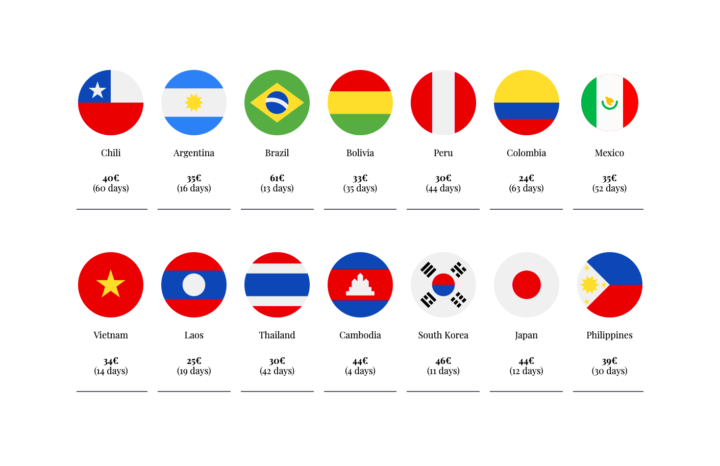
    We spent a total of 33€ per person. We haven’t negociated the rooms (I guess we should have).
  • One month in Bolivia

    One month in Bolivia

    After 5 beautiful days in Salta (Argentina), we crossed the border from La Quiaca to Villazon and started our trip in Bolivia! We started in Tupiza, did a 3 days tour of Uyuni, enjoyed Potosi and Sucre, a tour in Torotoro, La Paz, passed almost 2 weeks in Rurrenabaque, lived the Carnaval of Oruro, visited the ruins of Tiwanaku and finished our trip on Titicaca lake before crossing the border in Kasani.


    From Salta we took a night bus (2300Ars) and arrived in La Quiaca. Not much to see there but we’ve been stuck one day because of the form we hadn’t fill in online (phones and wifi connections were cut that day).

    After crossing the border (see the details of the process) we took a “colectivo” to Tupiza (20bol, 3h).

    Tip: Change only the minimum of your money there (we only received 1/3 of the value of our ARS) .

    Tupiza

    In Tupiza we stood 2 nights: 1st day we took rest, walking only to get money, to eat and to get an Entel card (you need to register at the Multicentro – we paid 10bs for the chip and 6Go).

    Second day we climbed to Cerro de la Cruz (8bs tuktuk with return).

    You can also go to ride horses for 15€ for 3h, and you can start a 4d/3n tours to Uyuni for 5000bs for a group of 4 people (1250bs/pers). Instead we decided to go to Uyuni directly and take a cheaper tour from there (650bs 3d/2n). 

    To sleep: Hôtel La Torre (147bs, with great breakfast)
    To eat: Churrasqueria Moises, pizzeria The Alamo
    To go to Uyuni from Tupiza: We took a bus at 12am (50bs, 5h trip)

    Uyuni

    Day 1:

    We started with the train cimentery. You will see the first locomotive (English one) brought there in 1850 mainly to send the silver to Chile and Argentina.

    Then we headed to the salar where you can only drive at 15km/h when it’s flooded. Between January and March is the rainy season.

    Good thing is you will enjoy the biggest mirror of the World. Bad thing you cannot access at Incahuasi island during this period.

    After a quick stop to the hotel to leave the food, we went to the “Ojos del Salar” where gaz is escaping.

    Then we had lunch near to the Dakar monument and the flags island. We enjoyed a full afternoon in the salar, playing with the mirror effect and staying until the sunset, the most beautiful of our life!

    We slept at a nice Salt hostel called Hostal Dulce Salada

    Price of Uyuni Tour (3d/2n): 650bs/person
    Included: 2 nights, food and boots (only necessary when you have the mirror effect, as the water can be 20cm deep).
    Not included:
    – the entrance of Parque Eduardo Avaroa (150bs)
    – the toilets (between 2 and 5bs)
    – the hot shower (20bs)
    Contact of our guide: Edwin +59163683925

    Day 2:

    We left at 8am for a long road to Valle de las Piedras where we had lunch. Then we passed by the volcan Oyahue and lagunas Hediondas and Honda and finally the Siloli desert (with the Stone Tree).

    we arrived at the entrance of the Parque Eduardo Avaroa at 5pm (150bs the entrance) and visited the mirador of Laguna Colorada (best time is before 4pm to appreciate the colours).

    Day 3:

    We woke up early to leave at 5am to appreciate the smoke of the geisers. At 7am we enjoyed the hot water of Chalviri and had a great breakfast there. We crossed the Dali desert and headed to Laguna Blanca, Laguna Verde and Licancabur volcan. The tour finished there and we went back to Uyuni passing the beautiful Laguna Kara and Laguna Pastos Grandes. We were back around 6.30pm.

    To sleep in Uyuni: Hostal Nichkito (147bs double room with breakfast) 
    How to go to Potosi from Uyuni: We took a bus at 11.30am (30bs) around 4h trip. You have many more departures all day long from the « terminal » Calle Arce.

    > See the trip to Uyuni from San Pedro de Atacama in Chile


    Potosi

    From the bus station we went directly to our hostel: a nice colonial house near by the center (30min walk going up to the hill, I would recommend to take a cab instead).

    The Casco Viejo is really beautiful. Potosi was the center of the World in the XVIIcentury due to the Cerro Rico full of silver. It’s also the second highest city of the World (4070m)! You can visit the mine still in activity, and still using people in very bad conditions (we didn’t)…

    On the main place you have a statue of Liberty copy in bronze which was dressed only 4 years after the one of NYC to celebrate the century of the Bolivian independance.

    The day after we visited the Money museum (40bs) and the cathedral. You also have the Torre de la Compañía but it was closed at that time. 

    To sleep: Hospedaje Maria Victoria (140bs double room with breakfast)
    To eat: American Burger (22bs)

    Sucre

    Considered for a lot of people as the capital of the country, it was indeed the center of upper Peru. Called Chacras, and then la Plata, this city with its white buildings is one of the most beautiful in Bolivia (and Patrimony of Humanity). If you want to enjoy the market you can have lunch on the 3rd floor with good Sopa De Mani (5bs) and Chorizo (15bs). The cemetery also worth the visit.

    Casa de la libertad

    Known as the first historic monument of the country, it’s where has been signed the independency. The tour guide will teach you the history of the revolution, talking about Bolivar, Sucre but also Juana Azurduy (entrance: 15bs)

    Convento San Felipe

    Before used as a Catholic Church and convent, it’s now a college you can only visit it from 2pm to 6pm (ring the bell on Nicolas Ortiz Street to enter). You will visit the church, the roof and if you’re luck the crypt! (entrance: 17bs)

    Recoleta

    Nice walk with nice view on the city. Not much to visit but the view worth the climbing!

    Museo of etnology (musef)

    Free museum with a lot of research made around the local traditions to understand the diversity of the Bolivian people. It stood in an old classical bank and house of Francisco Algardonia.

    Cafe de la torre

    Nearby the main place, this old church tower is now a coffee. You can enjoy a good breakfast behind the bells with great view on the city!

    San Francisco church

    Old Franciscan church with a terrasse on the roof to enjoy a good coffee!


    Torotoro

    From Sucre we took a night bus to Cochabamba (we left at 9pm and arrived at 4.30am) then a taxi to the colectivo at 6.30am. We arrived at 10am and went to the parc office to buy our entrances (100bs each). Behind this office you have the guides who presented us the options (you can split the cost with a group):

    • Hellas de dinausorios (dino’s footsteps), the Vergel waterfall and the Gran Canyon. 160bs (60 for the transport and 100 the guide)
    • Stone cathedral and ciudad de itas with cave speleology. 600bs for the transport and guide, and you need to add 12bs for the equipment and 2.5bs for the cave entrance per person
    • Tortugas cimentery and siete vueltas: 320bs

    As we were only 2 we took the first option. Our guide told us the moto taxi was cheaper if needed!

    How to go to Torotoro: The only way is to take a colectivo (35bs, 3h trip) from Cochabamba (Avenida Vallegrande – 20bs from the bus terminal or 30min walking)

    La Paz

    Here is a list of the main sightseeing’s in La Paz:

    • El alto and the biggest market in Latino America every Thursday and Sunday (best is to take the yellow line to 16 de Julio to have the full view of the city)
    • Mirador Killi Killi
    • Cementary
    • Archeology museum (closed for CoVid reason)
    • Historic center with Plaza Murillo and street Jaén
    • Plaza mayor de San Francisco and behind it the witch market (Calle Linares and Santa Cruz)
    • Challuma Hill with it’s coloured houses (above the red line)

    In one day you can also go to visit the Valle de La Luna or the Death Valley by bike.

    Where to eat or take a drink:
    – El Bestiario (café teatro with various shows and great food)
    – Costilla de Adam (craziest decoration ever)
    – Cafe Typica (in a nice garden)
    – El Popular: Gastronomic for only 70bs the menu (only for lunch)
    – DT Brew house (real draft beers)

    > Map of the cable cars

    How to go to La Paz from Cochabamba: From the Terminal there are plenty buses leaving all day long. We paid 40bs per person with Flota Cosmos (around 7h trip)
    How to go to La Paz from Rurrenabaque: You only have night buses leaving around 7pm. Check more info about Rurrenabaque.
    How to go to La Paz from Oruro: 35bs bus from the terminal, with plenty buses leaving all day long!

    Rurrenabaque: see the dedicated post


    Carnaval of Oruro

    Oruro carnaval is one of the biggest celebration in Latin America, on Unesco List of the Intangible Cultural Heritage of Humanity.

    Accomodation during Oruro Carnival: Prices of the hotels are amazingly raising for this event, so we shared a room with an other couple (784bs per night for a room with 4 beds).

    Seats tickets for the Carnival: You need to pay if you want to be seated and enjoy the parade of the 50 folkloric groups. We heard prices of seats between 150bs and 500bs, and we paid ourselves 220bs for the two days (from 6am to 2am). You buy it directly where you want to be seated.

    Parade: The parade starts from Avenida Villaroel, follows Avenida 6 de Agosto, Calle Bolivar, Plaza 10 de Febrero and ends to the Santuario Socavon (with dancers and musicians on their knees in respect to the Virgin).

    The city hasn’t really big interest, appart from the Virgin Monument you can reach by teleferic (20bs per person one way). We also visited the cathedral and Sovacon museum which is an old mine with a small sanctuary to Tio God (14bs for 15min visit + 3bs if you wanna take photos). This visit also includes a second museum with old artefacts found in the region and the traditional masks used during the Carnaval (small but nice).

    How to go to Oruro from La Paz: A lot of buses are leaving from the city center terminal. We paid only 25bs to go, and 35bs to go back.

    Tiwanaku (Tiahuanacu) and Pumapunku ruins

    After this week-end of carnaval we went back to La Paz for a night and left for Tihuanaku by the morning. Those ruins are incredible and the guide told us a lot about the history and traditions of Tiwanaku tribe. You can visit there a site with 3 temples, a piramid, a cimentary and 2 museums: one about ceramics, the second about llama and the biggest statue found on the site and in South America (Bennett Monolyth, 7.2m).

    Entrance fee: 100bs for tourists.
    Guide (I recommend): 80bs for the main site, 130bs for the 2 sites and 2 museums (we only paid 100bs for the whole tour, sharing with a Bolivian family).
    To go to Tiahuanaku from La Paz:
    Colectivo from the Terminal de Transporte Interprovincial de El Alto (close to the teleferic Estación UPEA). Around 1h30 and between 15bs and 20bs (if you cannot find colectivos for Tiahuanacu you can take one to Desaguadero: They’ll leave you on the main road, 30min walking to the city center and the ruins).
    To go back to La Paz we only paid 8bs picking a colectivo on the main road.

    Copacabana and Isla del Sol

    From the Terminal de Transporte Interprovincial de El Alto we took a colectivo to Copacabana (20bs, 3h) right after coming back from Tihuanaku. We arrived by night and visited the city the day after.

    We climbed to the hill of Horca del Inca, the Inca rock (falsy baptized by the Spanish when they arrived: Pachataka means “place where time is measured“). You can see there an old observatory made with 3 stones, but also stones cutted to be send to Tiahuanacu (said by the gardian who requested 10bs to go there). It would be great to have a guide there to tell us a bit more about this unknown site… We also saw a beautiful sunset on Cerro Calvaro, second great mirador.

    Second day we took a boat to the North part of Isla del Sol, which just reopened in December 2021! We paid 50bs round trip and as the boat was late (he left at 10am instead of 9.30) we went directly to the ruins (usually the boat leaves you on Challapampa Beach where you walk 45min to arrive to the ruins). It gave us the time to visit quickly the ruins (in 20min) and to go to the south by walk (3h – 9km). You can also go back to the boat which wait until 2pm before going to Yumani (south).

    Warning: The floating islands are FAKE! The real ones are in Peru (Puno). The ones they have on Isla del Sol or nearby Copacabana are made with barils and wood! Worse: they made you fish the trout from a fishnest…

    See also « From Titicaca to Cuzco » (2017)


    Summary of our trip:
    Day 1: Villazon – Tupiza
    Day 2-3: Tupiza
    Day 4-5-6: Uyuni tour
    Day 7-8: Potosi
    Day 9-10: Sucre
    Day 11-12-13: Torotoro (Julien was sick so we took rest there but 2 days are enough)
    Day 14-15: La Paz
    Day 16 to 24: Rurrenabaque
    Day 25-26: Oruro
    Day 27: Ruins or Tihuanaku
    Day 28-29: Titicaca
    Some words in Queshua:
    Acuripuna = vamos
    Eminacachanki = como estas
    Eminaparanicun = como almarecieron
    Vicuricuna = hay que comer
    Misky = rico
    Pachi = gracias

    Crossing the border La Quiaca – Villazon

    You first need to validate all this documentation in the Bolivian desk before having your exit stamp from Argentinian desk.

    Then you will cross the border to the health center where they take your temperature and age, and finally you will be registered in an other desk (they will send you print the copy of your passport with the page of the Argentinian stamps).

    Here we had the surprise not having our passeport stamped: they gave us a paper instead saying you will have to register everytime you arrive in a new place on their website (codes are your passeport number).

    Crossing the border in Kasani to Peru

    We exchanged our last pesos bolivianos in Copacabana with a perfect exchange rate (700bs => 379soles). We took a colectivo for 3bs per person (leaving on Plaza Sucre) to Kasani to cross the border. On Bolivian side they checked our updates on the migration website, and on Peruvian side they requested our vaccines and made us fill a form before checking our vitals. It was very fast (30min total to cross). Let’s go to Peru!!!


  • Uyuni salar

    Uyuni salar

    I couldn’t leave Chile before visiting this region in the border north of the country. So we booked a 3 days 4 nights tour with my chilean best friend and discovered real nature treasuries, like the region of the lakes, the geysers and warm water baths, inca’s hieroglyphs, canyons and volcanic formations, and cities lost in the desert… We Slept in a salt hotel before arriving to the main attraction: el Salar de Uyuni!


    Day 1: Lakes & Desert

     
    We started the tour from San Pedro. A mini bus took us at our hotel at 7.30am and took us first to the chilean custom desk – where you need to present your PDI entrance ticket – and we took the breakfast there (warmer than on the mountain). After 30min driving you will arrive to the Bolivian border where you’ll do an other line, get your passport stamp and finally start the tour (after a short last stop to buy the entrance ticket of the area)!

    The first day we met the group who will share the next days with us: Ahley, a canadian, Ignacio, mexican, Mylene and Laurane two frenchies, and our guide Nelson! We started the day playing on the frozen white lake (Laguna blanca), then we took a stop in Laguna verde, the green one (should be greener during the summer) in front of Licancabur volcan, and headed to the Dali desert and its volcanic stones (planted there after a huge volcanic eruption).

    We then arrived to a hot bath area, you can swim there if you want. Just Ashley did, we were too cold to think about taking of our clothes… After a quick lunch we kept going to the geysers, and finished the day to the most beautiful lake of the tour: Laguna Colorada. I can’t describe how beautiful it was in the end of the day, with the reflection of the mountains and the flamingos flying on the water.

    We arrived around 6pm at Villamar, a city lost in the desert, to have a coca tea and a light dinner.

    laguna blanca
    LAGUNA BLANCA
    laguna verde
    LAGUNA VERDE
    desierto de dali
    DESIERTO DE DALI
    GEISERS
    GEYSERS
    road desert
    THIS ROAD…
    laguna colorada
    LAGUNA COLORADA
    laguna colorada flamingo
    FLAMINGOS ON THE LAKE
    uyuni desert
    OTHER ROAD…
    Agency:
    We booked a tour with Flamingo Agency (on Caracoles street in San Pedro), it cost 130.000$ with nights, food and transport. You then need to change in San Pedro around 30.000 chilean pesos to have Bolivianos to pay the cactus island entrance, beers and souvenirs.

    Day 2: Rocks and canyons

    From Villamar we started the day by a rock full of old inca’s hieroglyphs, then our guide shown us la Copa del Mundo, a stone with an approximative form of the World cup, and la piedra del camello, a stone which look like a camel. After that we took a walk into a very nice canyon and climbed on the top to have an amazing view of the region.

    We then discovered Laguna Negra, a very nice area full of small rivers and lamas. We finished the tour by the Canyon of the Snake river, and made a break in a small city with a shop selling local beers, before arriving at Colcha K, in the Salt hotel “Samarikuna”. The hotel was nice but still very cold by night, we had a dinner where they told us it was flamingos but it looked like a LOT like chicken.

    Hieroglyphs

    Hieroglyphs

    Copa del Mundo

    Copa del Mundo

    El Camello

    El Camello

    The Climb

    The Climb

    Canyon del Serpiente

    Canyon del Serpiente

    Day 3: Salar de Uyuni

    We walked up very early to see the stars in the middle of the salar before arriving to Isla Incahuasi, a cactus hill in the middle of the salar. We were frozen, bought the entrance and waited the sunrise in a quiet place (on top it was really full of tourists). It was gorgeous to discover the immensity of the salar slowly appearing while the lights were shinning on. During the summer you may replace this sunrise by one on the water (frozen at this period…).

    We took our breakfast in the car park of this strange island, and went in the middle of the salt desert to play with pictures! Nelson, our guide, had everything planned: the famous dinosaur, a buddha and other games. It was a really fun time and nobody wanted to end this moment. But we had to keep going and stopped to the Banderas Monumento where you have almost all the flags of the World (all but one: the chilean one as they don’t really like each other…). Here we also found the starting point of Paris Dakar rallye, a very nice statue getting a bit old!

    We had lunch in Uyuni before finishing our trip with the train cemetery, and after saying goodbye to our friends, and a small visit of the city, we took a new colectivo to go back to Villamar (our first hotel) and just made one stop to San Cristobal.

    Dakar monument
    Dakar Monument
    cimentario de trenes
    Cimentario de trenes

    Day 4: Back to San Pedro

    The last day we left very early the hotel to arrive to the entrance of the parc at 7.30am, eat our breakfast and went back to the chilean border at 9am. They asked me to pay a tax to enter – 30 bolivianos or 3000 chilean pesos (I didn’t because I had my chilean resident ID). We were back around 11am in San Pedro de Atacama.

    Looking back…
    We were very happy of this tour, even if you feel like you follow a main touristic road we were almost alone. The only bad points are maybe the hotels too cold and the food very basic, but our guide was really easy going (only speak spanish though). We only missed the “Stone tree” (Piedra del arbol) and the giant mirror, frozen during winter.
    To fight the altitude:
    – Walk quietly, drink a lot (of water…)
    – Don’t run
    – Use coca leaves (take three, fold them and leave them in your mouth between your teeth and your gum).

    > Download the map of the region

    Pictures of the best moments!

  • From Titicaca to Cuzco

    From Titicaca to Cuzco

    In 15 days I’ve made a trip from La Paz to Cuzco, passing through Copacabana, Isla del Sol, Valle Sagrado (sacred valley), Machu Pichu and her sister: Choquequirao! I’ve met great people on my journey, I will never forget this travel which really changed my life…


    Copacabana

    From La Paz I directly took a “colectivo” to Titicaca Lake: a taxi from the airport first left me at the bus terminal El Alto and I joined other 9 bolivians for a 4 hours trip! Arriving to La Paz by night, I booked a ticket for la Isla del Sol the day after, and slept in the first hotel I found (very easy and very cheap – 4 euros a night).
    › See the pictures of this trip (on Facebook)

    The day after I visited Copacabana from 8am to 1pm (hour of the boat). It’s not a big city but it’s very nice and authentic. I had the chance to participate to the blessing of cars, very typical!
     

    Transports:
    – Taxi airport => El Alto: 50 bolivianos (20min)
    – La Paz => Copacabana: 50 BOL (4 hours)
    – Copacabana => Isla del Sol: 50 BOL round trip (2 hours)
    – Copacabana => Cuzco: 170 BOL or 140 with a semi cama, less confortable (6 hours + the border control)
    Copacabana

    Here is the top 5 to do:

    Cerro Calvario

    cerro calvario

    Visit the cathedral

    catedral de copacabana

    Capilla de velas

    capilla de velas

    Walk in the streets

    Copacabana

    Eat in the Market

    Copacabana

    Let’s go to the origin of the Inca empire…

    Isla del Sol

    Isla del sol

    There was only two options to go to Isla del Sol: in the morning (8am) or in the evening (1pm), and same to go back (10am and 15pm). The second problem was where they left me (after two hours): the south port (Yumani) instead of the north one (Chinkana), where you actually can see the most interesting ruins. The locals people told me there was a conflict between the three communities and the North were blocked. So I suggested with a group of travelers I met there to wake up early and pass the controls before the sunrise… And it worked, leaving at 5.30am!

    After approximately 9km and 3h walking we finally discovered a sacred stone, a ritual table (for the sacrifices of lamas) and the ruins of Chinkana, a huge village / fort / labyrinth! It really worth the pain – because walking at 3800m is a challenge – and we decided to go back from the other way, longer and around the coast… Going up and down the hills… If you’re not sportive I would suggest to go back from the same path! We were back in the south just in time to take the boat (you can ask to take one which stop to the small ruins in the south), and I directly took my confortable night bus to Cuzco.

    Looking back…
    In Copacabana I didn’t have time but you can also take a trip to islas flotantes (floated island) and Isla de la Luna (Moon Island) where there are some ruins. I neither had the force to go to el Horca del Inca, a second hill but it seems to offer a great view of the city!
    Tips:
    – To fight the altitude: Walk quietly, drink a lot (of water…) and use coca leaves (take three, fold them and leave them in your mouth between your teeth and your gum).
    – Always negociate the prices in Bolivia!
    › Take a look on this trip (on Facebook)

    Arrived in Cuzco I followed Luciana, one of the argentinian girl with Johann, the martinican, and we met Ana, an other Argentinian! We booked an hostel and met a guide recommended by Lupi which sold us a 1 day tour of Sacred Valley, 3 days 2 night for Machu Pichu and 4 days to Choquequirao.

    Valle Sagrado

    I would recommend to rent a car and go by yourself to the Sacred Valley (same for the Machu Pichu). The guide explainations are very interesting but it’s really easy to go there…

    Here are the sites you can visit in one day in Sacred Valley:

    Chinchero

    Chinchero

    Moray

    Moray

    Salineras de Maras

    Salineras Maras

    Ollantaytambo

    Ollantaytambo

    Písac

    pisaq

    Machu Pichu in 3 days & 2 nights

    Early in the morning we took the bus until Hydroelectrica (7 hours), we arrived by noun, took a break to lunch and followed the railway to Aguas Calientes (3 hours walk, but you can also take a train from Cuzco to Aguas Calientes).

    The second day we walked up early to go to the bridge where you start to climb 1h30 to the Machu Pichu. They opened the gate around 6am but there was already a big line at 5… Arriving on top we had to wait for a group to start the tour at 8am. Honestly we escaped very quickly with Luciana to visit at our rythm. So we missed the explanations, but we really passed an unforgettable moment! Johan had the patience to follow the group and told us it was interesting but very calculated to lead the group close to the exit after 4h visit.

    We get back around noun to Aguas Calientes and took rest, drinking great Pisco Sour(s). The third day we had to go back to Hydroelectrica to get our bus at 2pm, and made a stop in a nice parc where you’ve got typical plants and a nice waterfall (Cataratas de Mandor, not really crazy). It tooks 9 hours to go back (by night it’s slower).

    Machu Pichu
    Tips:
    – If you have time and force, follow the end of the Inca Trail to have an amazing view of the site!
    – You can also do this trip with just one night, but you need to leave the Machu Pichu at 11am to get the bus to Hydroelectrica on time!
    – We already had the entrance ticket for the Machu Pichu, it’s recommended to buy it in Cuzco but you can also do it in Aguas Calientes. IMPORTANT: Huayna Pichu ticket is very hard to get because they allow only 400 persons per day…

    Choquequirao in 4 days

    Back to Cuzco we ‘ve been invited in our guide family in Chincheros and shared with them the lunch and a very nice afternoon (thanks Hermo!), a very necessary break to prepare us to the trekking to Choquequirao…

    Choquequirao is the last inca bastion, hard to access so empty of tourists (big diference from Machu Pichu)! It was great to have a guide to lead us, but his plan didn’t allow us to have time to visit the whole site (a shame when you know you passed through the 6th deepest canyon of the World to get there).

    1st day you leave Cuzco and take the bus direction Abancay until Cachora crossing (around 4 hours), then a taxi to the entrance of the trek path (one more hour). From there you start walking, we chose not to rent the service of horses to carry our backpack, BIG MISTAKE. This day we went down the hill (9km, 1600m of negative level) until a bridge, and climbed to Santa Rosa Camp (3km, 700m positive) in about 7 hours.

    The second day we paid a horse to carry our bags, really too heavy to climb this huge mountain… After two hours, 4km and 1000m positive level we arrived to Marampata and saw far far away Choquequirao. We prepared the camp for the other night and took back the walk… After others 5km and 2h you finally arrive to this huge site.

    Choquequirao

    It’s really hard for me to describe those ruins… I will just share with you those white qwarts lamas you can see on one of the hill… We passed around 3 hours there, but didn’t have time to visit everything sadly… We needed to go back before the sunset and couldn’t stand an other day… So we went back to the camp arriving by night.

    The third day woke up at 6am to start to go back to Chiqisqa, one hour after the bridge to take a deserved break! From 11am it’s really hard to walk so we started the last day at 5am by night to arrive by 8 on the top and we asked a driver who left a group to start the expedition to bring back us to Cuzco.

    › Check this travel’s pictures (on Facebook)

    This trip is the hardest I’ve ever made but it’s also the best in my life!

    Cuzco

    Cuzco

    Back to Cuzco I only had one day so I took a Tour for tips which helped me to see everything in the short time I had (various are starting from the principal place – Plaza Mayor). On this same place you will find the main cathedral. Take a look inside, there’s a painted of “The Last Supper” with one funny detail: they’re eating a Cuy (the hamster you can traditionally eat in Peru)! This is just one example of the colonialism presence in this city. All the buildings are literally built on the ruins of the original city (you still can see the original stones). Even the river crossing the city has been covered…
     

    Looking Back…
    – I didn’t have time to fully visit Sacsayhuamán in the north of the city, but it’s definitly something to do!
    To sleep: I fully recommend Puriwasi Hostel, cheap and perfect location
    To eat: San Pedro Market or the Limbus restaurant (San Blas area)

    Top 5 to do in Cuzco:

    Inka Museum

    museo del inca

    Coricancha

    Coricancha

    San Blas quarter

    San Blas

    San Pedro Market

    Ollantaytambo

    Hatun Rumiyuq

    Calle Hatun Rumiyuq
    Summary:
    – Day 1: La Paz => Copacabana
    – Day 2: Copacabana => Isla del Sol
    – Day 3: Cuzco
    – Day 4 to 7: Machu Pichu
    – Day 8: Chinchero BBQ
    – Day 9 to 12: Choquequirao
    – Day 13: Cuzco (bus by night to La Paz – 20 soles)
    – Day 14 to 15: La Paz
    Maps:
    › Isla del Sol
    › Valle Sagrado
    › Choquequirao


    Thank you guys, I’ve passed magic moment with you…